

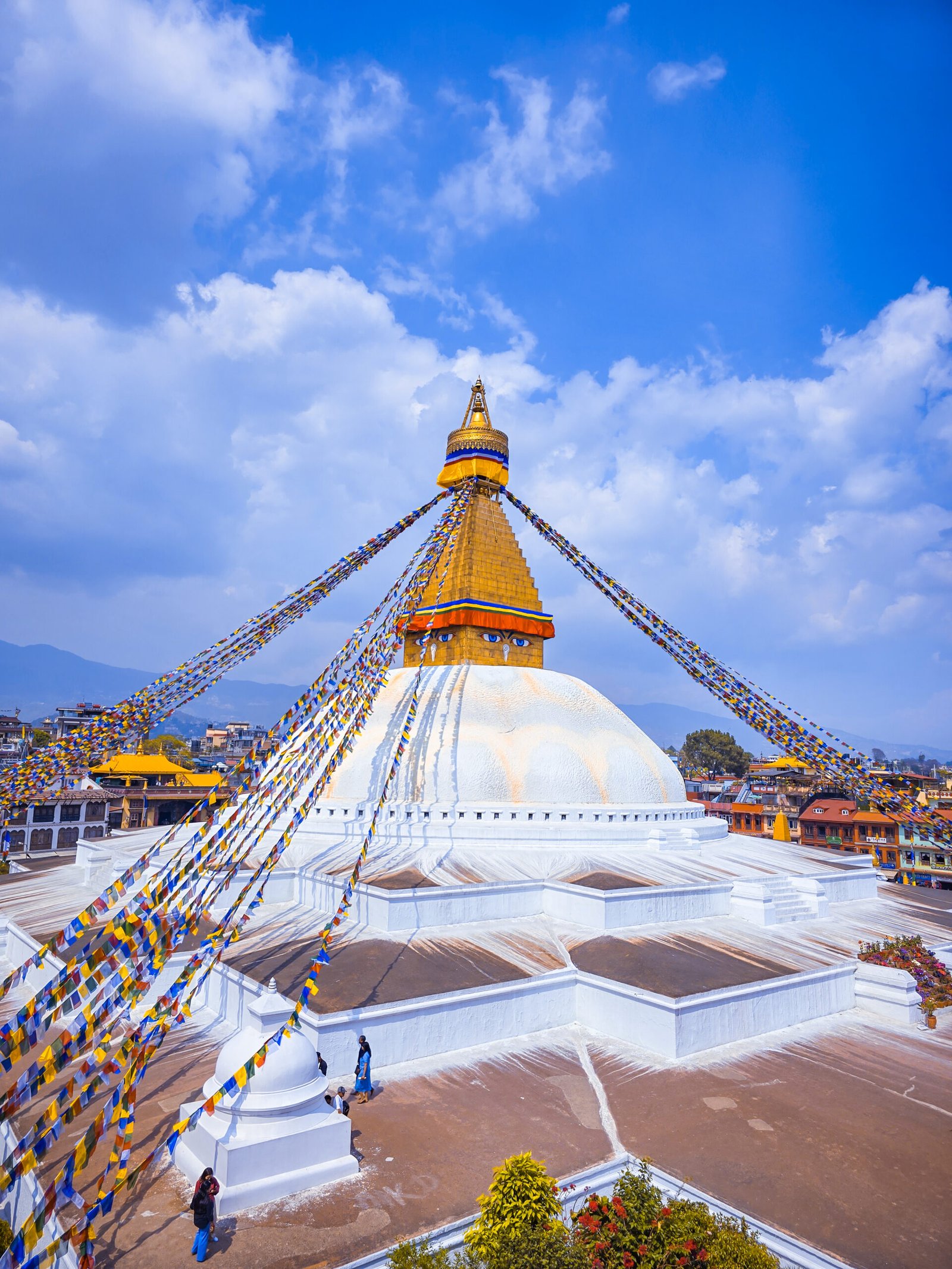
NEPAL & BHUTAN
Kathmandu – Nagarkot – Kathmandu – Paro – Thimphu – Punakha – Paro – Kathmandu
Itinerary | |
| Day 01 (April 5) | Brussels – Kathmandu, Arrive in Kathmandu on April 17 at 2:40 pm |
| Day 02 (April 6) | Kathmandu |
| Day 03 (April 7) | Kathmandu |
| Day 04 (April 8) | Kathmandu-Nagarkot via Bhaktapur |
| Day 05 (April 9) | Nagarkot- Kathmandu |
| Day 06 (April 10) | Kathmandu- Paro (Bhutan) via Flight, overnight in Thimphu |
| Day 07 (April 11) | Thimphu |
| Day 08 (April 12) | Thimphu – Punakha |
| Day 09 (April 13) | Punakha |
| Day 10 (April 14) | Punakha – Paro |
| Day 11 (April 15) | Paro |
| Day 12 (April 16) | Paro – Kathmandu Via overnight flight to Kathmandu. |
| Day 13 (April 17) | Kathmandu-Brussels |
Departing for the flight from Kathmandu.
You'll be thrilled to watch the scenic flight to Kathmandu with the view of the snow-capped Himalayan peaks stretching out; You'll already be looking forward to exploring the country. Our English-speaking representative/guide of the agency will meet you at the airport terminal and transfer to the hotel.
After the long trip, the day will be dedicated to rest and a short walk around the hotel to have a first local touch of Nepalese culture.
After breakfast, your full-day tour begins, you'll visit four major Kathmandu landmarks, including Pashupatinath, Boudhanath, Swoyambhunath (Monkey Temple), and Kathmandu Durbar Square.
First visit to Swoyambhunath, also known as the Monkey Temple – a 2500-year-old monument; it is said to be the radiant lotus of valley mythology, established when Manjushree, the god of wisdom, drained water. This temple is a famous pilgrimage site for Buddhists and is located on a beautiful hill inside the Kathmandu Valley. It is located on top of a hill that can be seen from almost every part of the Kathmandu Valley. Tourists call this Stupa "Monkey Temple" because many monkeys live around the place. After visiting the Monkey Temple, we head to another landmark, Boudhanath Stupa.
The stupa of Budhanath was renovated after the 2015 earthquake as it was also affected. The Boudhanath stupa is the largest stupa in the world and represents Tibetan Buddhist culture in Nepal. Antique shops around this stupa where you can buy things of your preferences regarding Tibetan culture and lifestyles. After a visit to Boudhanath, you will be transferred to the Pashupatinath Temple, located on the bank of the Bagmati River.
Pashupatinath is a sacred temple for Hindus as many people from different parts of the world visit this temple every year and during the Shiva Ratri, hundreds of thousands of devotees and Sadhus come to attend.
The last site of this day is Kathmandu's Durbar Square, Hanuman Dhoka, the former royal residential area, Mahadev Parvati Temple, the home of Kumari (living goddess) temple around this Durbar Square. Stroll through the local bazaar and return to the hotel.
After breakfast at the hotel, we take you to Patan Durbar Square to explore Patan Durbars, Mahaboudha, Krishna Temple, Kumbeshwor Temple, Golden Temple, etc. You get the impression that Patan has been displayed in front of you as an open museum featuring stunning carved windows, intrinsic roof struts, statues of gods and goddesses, temples designed in pagoda style with erotic carvings and metal faces, and many other beautiful facets. In addition, you will also be able to see the Patan Handicraft Center and continue driving to Bhaktapur Durbar Square.
Bhaktapur Durbar Square is home to a unique culture and the finest display of handicrafts. It is said that Bhaktapur is the only place in Nepal that has not been touched by Western culture. The Golden Gate, the Lion's Gate, the Art Gallery, the Nyatapola Temple, the statue of King Bhupindra, and the fifty-five-window Malla Palace are the pride of Bhaktapur. We'll tour this place and travel to Nagarkot. Dinner and overnight at the hotel in Nagarkot
Wake up early in the morning for the sunrise view, either from the hotel or you can take a half-hour hike to reach the observation tower. In the morning, you will witness the sunrise; offering the most beautiful views from Dhaulagiri in the west to Kanchenjunga in the east. After breakfast, you explore the surroundings of Nagarkot and take a short walk and return to Kathmandu. In the afternoon, you are free to go shopping or relax.
Depending on the time of your flight, you will be transferred to the airport for the final departure to Paro (Bhutan). The flight to Paro is one of the most spectacular in the entire Himalayas. Flying along the Himalayan range from Kathmandu, the journey offers mesmerizing views and an exciting descent into the Kingdom.
After the immigration formalities, you will be greeted by our representative/guide with a "Tashi Khaddar" (white scarf offering to the guest, which is a good omen way to greet the guest. After the welcome ceremony, board the vehicle and head to Thimphu, the capital of Bhutan, the road through the Paro Valley to the confluence of the Paro and Thimphu rivers in Chuzom (confluence) en route visit Tamchog Lhakhang is a temple dedicated to the 13th century saint Thangthong Gyalpo, the bridge builder. This temple is located on the other side of the river, from Paro to Thimphu. To get to the temple, you must cross an iron chain bridge, one of the few remaining among the many that Thangthong Gyalpo built.
Upon arrival in Thimphu, check in at the hotel. The capital of Bhutan and the center of government, religion, and commerce, Thimphu is a unique city with an unusual blend of modern development and ancient traditions. Although not what you would expect from a capital city, Thimphu is still a suitable and lively place. Home to civil servants, expatriates, and monks, Thimphu retains a strong national character in its architectural style.
After lunch, drive to visit Buddha Point (Kuensel Phodrang). You can pay your respects and offer prayers to the Buddha, the largest statue in the country, and then a walk around the area. The area also offers excellent views of the Thimphu Valley from the west.
In the evening, an exploratory walk around the main street of Thimphu and the market. Also visit the local handicrafts bazaar, to see examples of Bhutan's traditional fine arts. Here you can buy hand-woven textiles, Thangkha paintings, masks, ceramics, slate and wooden sculptures, jewelry, interesting objects made from local materials.
Overnight at the hotel in Thimphu (altitude 2400m).
After breakfast, take a short drive to the northern end of Changangkha Lhakhang, built in the 12th century: it's a temple-like fortress and monastic school perched on a ridge above Thimphu, south of Motithang.
Later, visit the Takin Reserve: The Takin is the national animal of Bhutan, and looks like a cross between a cow and a goat. Legend has it that the animal was created by the great Buddhist yogi, Drupa Kunley, and is only found in Bhutan and nearby regions. Taxonomists place the animal in a category of its own because it is not similar enough to any other animal to fit the established categories.
Later, visit Simply Bhutan which offers live performances for the dance and cultures of Bhutan.
Later, visit to the King's Memorial Chorten continually made the rounds of people, muttering mantras and spinning their prayer wheels. The construction of this monument was the brainchild of the third king of Bhutan, His Majesty Jigme Dorji Wangchuk ("the father of modern Bhutan") who wished to erect a monument to world peace and prosperity. Completed in 1974 after his untimely death, it serves as both a memorial to the late king and a monument to peace.
Continue higher to visit Trashi chhoedzong, "fortress of the glorious religion". It is the center of government and religion, the site of the monarch's throne room, and the seat of Je Khenpo or chief abbot. Built in 1641 by Bhutan's political and religious unifier, Shabdrung Ngawang Namgyal, it was rebuilt in the 1960s in the traditional Bhutanese way, with no nails or architectural plans.
Overnight at the hotel in Thimphu.
After breakfast, drive to Punakha through the Dochula Pass (3O8Om). In Bhutan, the passes are marked with a large Bhutanese Chorten and a prayer flag. The Dochula Pass offers the most spectacular view of the high peaks of the Eastern Himalayas on a clear day.
Later in the day, excursion to Chimi Lhakhang (from the hotel it takes about 15 minute’s drive to the carriage road, then the walk starts through rice fields and villages. It's a total of about 1 hour of walking, (round trip). The Chimi Lhakhang, located on a hill in the center of the valley, also known as the Fertility Temple. It is widely accepted that couples who do not have children and want one, if they pray in this temple, they are usually blessed with a child very quickly. The trail leads through rice paddies to the small village of Pana, which means "field." A walk through the village near the temple will give you a rare insight into the daily life and lifestyle of the villagers.
After check-in at the hotel, visit Punakha Dzong, a massive structure built at the junction of two rivers. It was the capital of Bhutan until 1955 and still serves as the winter residence of the monks.
Overnight at the hotel in Punakha.
After breakfast, hike through the fields of chilies, cabbages and rice along the banks of the Mo Chhu to Khamsum Yuelley Namgyal Chorten, an amazing monument recently built by the queens and consecrated in 1999.
Later, visit to Sangchhen Dorji Lhuendrup Lhakhang Convent. Perched on a ridge among pine trees and overlooking the valleys of Punakha and Wangdue Phodrang, shine the magnificent structures of the Sangchhen Dorji Lhuendrup Lhakhang (temple). The temple houses a 14-foot bronze main statue of Avalokiteshvara (Chenrigzig chagtong chentong). Other statues include those of Guru Padma Sambawa, Gautama Buddha, Zhabdrung Ngawang Namgyel, Tsela Namsum, the 21 Taras, and Tsepamay (Buddha of Longevity). The statue of Avalokiteshvara, one of the largest in the country, was the work of entirely local Bhutanese craftsmen. The temple complex also houses a permanent center of higher education and meditation for nuns where, in addition to religious training, it provides training in life skills such as sewing, embroidery, statue-making, and thangka painting.
Overnight at the hotel in Punakha.
After breakfast, check out from the hotel and drive to Paro along the scenic road, visit Simtokha Dzong, the oldest fortress in the country built in 1627 which now houses the school of Buddhist studies.
Upon arrival in Paro, check in to the hotel. After lunch, visit Ta Dzong, originally built as a Watchtower, which now houses the National Museum. The extensive collection includes ancient Thangkha paintings, textiles, weapons and armor, household items, and a rich assortment of natural and historical artifacts.
Visit Ta Dzong immediately followed by a short walk on the trail to visit Rinpung Dzong (ParoDzong, which means "fortress of the pile of jewels"), which has a long and fascinating history. Along the wooden galleries lining the inner courtyard are beautiful murals depicting Buddhist traditions such as Four Friends, the Old Man of Long Life, the Wheel of Life, scenes from the life of Milarepa, Mount Sumeru and other cosmic mandalas.
In the evening, enjoy the traditional herbal hot stone bath at the farm (additional cost). The traditional Bhutanese hot stone bath, known as Dotsho in the local language, has been practiced in Bhutan for centuries as a medicinal bath. Many Bhutanese believe that bathing helps to heal joint pain, relax, and other medical problems. The river stones are heated and then put in the water to heat the water; Sometimes medicinal herbs are added to the water before it is ready for soaking.
Overnight at the hotel in Paro.
After breakfast, excursion to Taktshang Monastery or Tiger's Nest Up Camp Low: This is one of the most famous monasteries in Bhutan, perched on the side of a cliff 900 m above the bottom of the Paro Valley. It is said that Guru Rinpoche arrived here on the back of a tigress and meditated in this monastery and that is why it is called "Tiger's Nest". This site was recognized as a most sacred place and visited by Shabdrung Ngawang Namgyal in 1646 and now visited by all Bhutanese at least once in their lives. On April 19, 1998, a fire severely damaged the main structure of the building, but now this Bhutanese gem has been restored to its original splendour.
After that, we take the road to the Chele la Pass, at an altitude of 3,988 meters, is considered one of the highest passable in Bhutan. About an hour's drive along a densely forested road, lies this pass, a botanical paradise. The pass offers stunning views of the sacred Jomolhari Mountain and Jichu Drake. It is also marked by hundreds of prayer flags fluttering in the wind. It is also a great place to take a short walk, enjoying panoramic views. Here, visitors can see waterfalls of wild roses; purple and yellow primroses; and deep blue bands of irises covering the forest floor. The top of the collar blooms with rhododendrons in a variety of colors – pale pink, dark pink, burnt orange, mauve, white, and scarlet.
Famous sites in this area are: Lhakhang Karpo (White Temple) and Lhakhang Nagpo (Black Temple) from the 7th century at the foot of three revered fraternal mountains known as Meri Puensum. The annual great Haa Tshechu is also celebrated here in Lhakhang Karpo from the 8th to the 10th day of the 8th month of Bhutanese.
Overnight at the hotel in Paro.
After breakfast, Depart for Paro airport for the flight from Kathmandu. Return to Kathmandu, transfer to hotel and a free day for private activities depending on the time to arrive.
Farewell dinner and return to the hotel to change and transferred to the airport in the late night.