

North India – Mystical Rajasthan & the Sacred Colors of Holi
Delhi – Mandawa – Bikaner – Dechu – Jodhpur – Jaipur – Agra – Delhi
Everything that makes you think of India can be found in Rajasthan: The palaces of the maharajahs, the women in colourful saris, the proud men with their turbans and the deep gaze of the brave ancient warriors, the elephants in the street, the camels pulling carts, the monkeys and the countless temples. Enhanced by the aridity of the Thar Desert, the cities contrast with their colourful names: Jaipur the rose
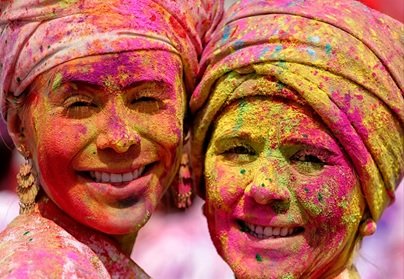
Painted faces, clothes soaked in coloured water, songs and dances, Holi is one of the most famous and joyful festivals in India. Of Hindu origin, it is nevertheless celebrated throughout India by all religions and castes… Festival of the equinox, Holi celebrates the end of winter… During the festival of colours, many people go wild by spraying themselves with colour. Faces and bodies are covered in red, yellow, green, etc. Discarded pigments have a very specific meaning: green for harmony, orange for optimism, blue for vitality and red for joy and love.
- Flight Brussels / Delhi on February 25 in the evening or late at night.
- Assistance by French/English speaking representative and transfer to the hotel.
- Transfer to a hotel near the airport for breakfast and change.
- Breakfast at the hotel.
- Leave for the visit of Old Delhi. The first center of Mughal power, Old Delhi has ancient monuments, narrow streets, and bustling bazaars. Starting from the Red Fort, built in 1648, you will set off on a pedicab ride through "Chandni Chowk" or the Street of Money, where all your senses will be awakened in this very lively avenue. Then, visit the Jama Masjid, the largest mosque in India, completed in 1658 by Shah Jahan who also built the Taj Mahal, and the Raj Ghat, the sober memorial of Mahatma Gandhi.
- Lunch at a local restaurant.
- Delhi, with a population of 14 million, is divided between the old and the new city. NEW DELHI with its wide, cool and clean avenues, OLD DELHI with its small streets teeming with temples, monuments and bazaars. Eight imperial dynasties and a republic made the present city.
- Dinner and overnight at the hotel.
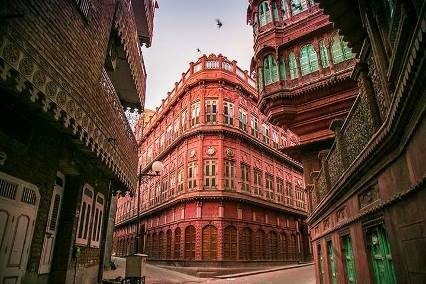
- Departure to NAWALGARH, a small feudal principality in the very picturesque Shekhawati region, where the facades decorated with "havelis", painted with beautiful frescoes, tell visitors stories and legends.
- Late lunch on the road.
- Arrival, end of the day in Nawalgarh and check in at your hotel.
- Dinner and puppet show at the hotel.
- Overnight at the hotel.
- Breakfast at the hotel.
- Discovery of the village of Nawalgarh and the havelis.
Dwellings of maharajahs and merchants with their galleries festooned with domes and naïve paintings full of colour. You will discover the houses entirely covered with frescoes illustrating war legends, daily life or religious myths.
- Departure by road to Bikaner, a city in the Thar desert, former princely capital of the fifteenth century. The city rises on a small plateau which gives it an imposing air which is further reinforced by the marvellous crenelated ramparts that surround it. Bikaner is the birthplace of the famous Camel Corp which played a big role in the desert wars.
- Upon arrival in Bikaner, lunch and check-in at the hotel.
- The visit of the city of Bikaner: the Junnagarth Fort. You will take a ride of the old city by tuk tuk to mingle with the Indian people and understand the local life and the original meaning of India with the colours and cows strolling on the Indian streets. Walk through the local vegetable market and cake tasting at a very famous pastry shop.
- At the end of the day, continue to the hotel in Bikaner.
- Dinner and overnight at the hotel.
- Breakfast at the hotel.
- Depart for the Thar desert region towards DECHU and a visit to the school.
Visit the school (depends on school days and holidays).
| Stop in the village near Dechu for a meeting at the public school and learn a few words in Hindi. |
Upon arriving in Dechu, lunch in the RESORT and then in a 4X4 outing to visit the Bishnoi villages and attend their daily life: visit the houses of the Bishnois and participate/learn about their version of ecology » Safari in a 4X4 on the sand dunes of the region.
- End of the day arrival in the LUXURY CAMP in the middle of the desert and installation for one night.
Local folk dance in the open air, dinner and accommodation in the desert.
- Breakfast at the hotel.
- Continue by road to Jodhpur, the ancient capital of Marwar which, at the gates of the Thar desert, seems to emerge from the sands. Enclosed between its walls pierced by seven massive gates, the old, fortified city, once a caravan centre and a flourishing city watched over by the fortress of Mehrangarh, has hardly changed since the time of the Great Mughals.
- Lunch in the local restaurant.
- City tour. The city stands in the heart of the desert. It is surrounded by a wall 10 km in circumference that protects it from the sand. You will see the Mehrangarh Fort, which must have been practically impregnable in times of war. For many miles around, it dominates the landscape. It is home to exquisite palaces decorated with wall frescoes and stone lace. Then the Jaswant Thada, built of white marble, is the memorial of the deceased kings of Jodhpur.
- In the evening, a walk in the city where the women of Jodhpur dressed in colourful saris are a spectacle in themselves.
- Dinner and overnight at the hotel.
- Breakfast at the hotel.
- Depart in the direction of Pushkar, have lunch on the road race in Pushkar with a visit to the Sacred City.
Legend has it that the gods released a swan with a lotus in its beak. He had to drop this lotus at the place where Brahma was to perform a yagna (Hindu ritual). It was in Pushkar that he brought down this lotus. This is why Pushkar is one of the few places in India where a temple to the god Brahma is dedicated. Pushkar is an important pilgrimage site. The city is located on the shores of Lake Pushkar. 52 ghats allow pilgrims to descend to the lake level to bathe in the sacred waters. Every year in November, one of the largest camel fairs takes place here.
- Afternoon visit to Pushkar Sacred Lake and a meeting with a priest who will explain Indian mythology with a prayer to attend and discover spirituality and peace at the edge of Pushkar Sacred Lake. Known worldwide for the BRAMHA temple and for its charm with the colours and local life.
- Drive to Jaipur and check in to the hotel.
- In the evening, a possibility of a walk in the streets of Jaipur where the Indians start to gather wood to light the big fire called Holika. On the eve of the festival, huge bonfires are lit in all the cities of India. These fires, which celebrate the cremation of Holika, sister of King Hiranyakashipu, symbolize the destruction of evil. (If possible)
- Dinner and overnight at the hotel.
Breakfast at the hotel and departure for the FESTIVAL OF HOLI.
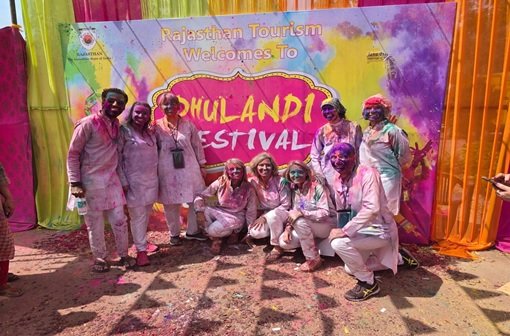
Transfer to Khasa Kothi to celebrate the Holi Colour Festival.
Holi: during this second day, known as Rangapanchami, people, dressed in white, circulate with coloured pigments that they throw to each other, it is then customary to apologize, after having sacrificed to the coloured rite, with "Bura na mano, Holî hai" ("Don't be angry, it's Holi" in Hindi). It is also an opportunity to share dishes prepared especially for this occasion.
The pigments they throw at each other have a very specific meaning: green for harmony, orange for optimism, blue for vitality and red for joy and love.
According to the Indianist writer Alain Daniélou, the festival of Holi is "the day when all castes mingle, when the inferiors have the right to insult all those to whom they have had to bow throughout the year"
Lunch will be organized with local folklore in a Garden and Local Restaurant.
Notes: Cover your skin with oil and wear clothes that you can throw away.
Return to your hotel in the afternoon to change and relax.
Notes: Cover your skin with oil and wear clothes that you can throw away.
Dinner and overnight at your hotel.
- Breakfast at the hotel and departure for the tour.
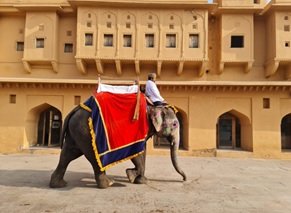
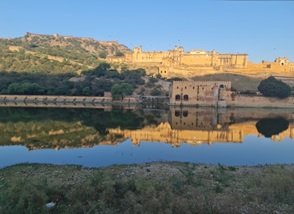
- Departure for the visit of the Amber Fort in the time of the Mughals, the region must have always been ready for war. Amber was the residence of the Maharajahs. By seeing the defensive forts that surround the place, you will be able to imagine the power of the character. Climb to the ramparts on the back of an elephant or in a jeep.
- Discovery of the city "JANTAR MANTAR", visit of the Jantar Observatory Mantar is a witness to the passion of Maharaja Jaisingh II for astronomy. He built observatories, including that of Jaipur (1728/1733). These monumental instruments with strange shapes, sundials, ramps and graduated arcs make it possible to read the latitudes and longitudes and the distances between celestial bodies, the time corresponding to the meridian of Jaipur, etc.
- Visit the city passing in front of the famous Palace of the Winds. Visit to the City Palace.
- Visit of a workshop of stones and jewelry, handmade and specialty of Jaipur.
- Lunch during the visits.
- End of the day, a rickshaw ride to help you discover the pink city and discover
From the local town with its bazaars and local textiles.
- Dinner and overnight at the hotel.
- Breakfast at the hotel.
- Continue to Agra, lunch on the road and check in at the hotel.
- At sunset visit the famous and moving Taj Mahal (closed on Fridays). It was built by the Mughal emperor Shah Jahan in memory of his beloved wife Mumtaz Mahal. The construction of the Taj Mahal began in 1631, the same year as Mumtaz Mahal's death, and was not completed until 1653.
Dinner and overnight at the hotel.