

RAJASTHAN: IN THE FOOTSTEPS OF THE MAHARAJAS AND SPIRITUALITY
Delhi – Nawalgarh – Bikaner – Jodhpur – Udaipur – Pushkar – Jaipur – Agra – Delhi – Oracha – Khajraoo – Varanasi – Gaya – Delhi A country where we can not only enjoy cultural festivals, but also beautiful palaces and architectural works of art. And for the more adventurous, what better way than to start a new year with a visit to RAJASTHAN.
Everything that makes you think of India can be found in Rajasthan: The palaces of the maharajahs, the women in colourful saris, the proud men with their turbans and the deep gaze of the brave ancient warriors, the elephants in the street, the camels pulling carts.
- Flight Paris / Delhi
- Arrival at Delhi International Airport. The room will be available from 1 p.m.
- Assistance by French/English speaking representative and transfer to the hotel.
- Lunch at a local restaurant.
- Delhi, with a population of 14 million, is divided between the old and the new city. NEW DELHI with its wide, cool and clean avenues, OLD DELHI with its small streets teeming with temples, monuments and bazaars. Eight imperial dynasties and a republic made the present city.
- Breakfast at the hotel.
- Departure by road to NAWALGARH, a small feudal principality in the very picturesque region of Shekawati. Arrival and check-in at the hotel.
- Visit to the site of Mandawa Here, the history of the great battles is in every corner, the underground where the warriors could escape the victors are still there. Every corner of the palace is a surprise.
- Lunch at the local restaurant on the road.
- Dinner and overnight at the hotel.
- Breakfast at the hotel.
- Departure by road to Bikaner, a city in the Thar desert, former princely capital of the fifteenth century. The city rises on a small plateau which gives it an imposing air which is further reinforced by the marvellous crenellated ramparts that surround it. Bîkaner is the birthplace of the famous Camel Corp which played a big role in the desert wars.
- Lunch at the hotel.
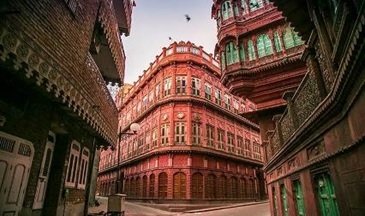
- The visit of the city of Bikaner : The Junnagarth Fort. You will discover the city and its colours with a ride of the old town by tuk tuk and a walk in the vegetable market.
- Dinner and overnight at the hotel.
- Breakfast at the hotel and departure to Jodhpur.
- Jodhpur, also called "the blue city" because of the cladding of its houses. Blue was traditionally the color of the Brahmins, but today it is used by everyone and is said to have the quality of repelling insects! It is in the heart of the desert a city nestled at the foot of a fortress, an enormous millstone of dark red sandstone where the forces of many conquerors wore out. Jodhpur appears like a comforting oasis to the traveller who has just crossed the Thar desert. The old town is surrounded by a perimeter wall pierced by seven gates, which was erected in the middle of the sixteenth century on a perimeter of almost 10 km, which also protects it from sand.
- Discovery of the red fortress of Mehrangarh perched on its hill, from where the panoramic view of the city, with its white and blue whitewashed houses, is magnificent.
- Continue to Jaswant Thada, the royal white marble mausoleum of Maharaja Singh II, built in 1899.
- A walk in the city where the women of Jodhpur dressed in colourful saris are a spectacle in themselves. We'll go to the spice souk set up around the clock tower.
- Discovered from the Desert Women's Textile Factory, handcrafted and historic. Meet women and understand the nomadic life and their textiles, known all over the world.
- Lunch in the local restaurant.
- Dinner and overnight at the hotel.
- Breakfast at the hotel.
- Along the way, visit the Jain temples of Ranakpur, whose twenty-nine halls supported by two hundred pillars have managed to escape looting. Adinath, to whom these temples are dedicated, is represented in the acrobatic positions of the Hindu deities. It has no less than twenty domes of different sizes and heights. It is an extraordinary example of the virtuosity of the craftsmen of the time who cut marble with the refinement of a goldsmith. (The temple open at noon).
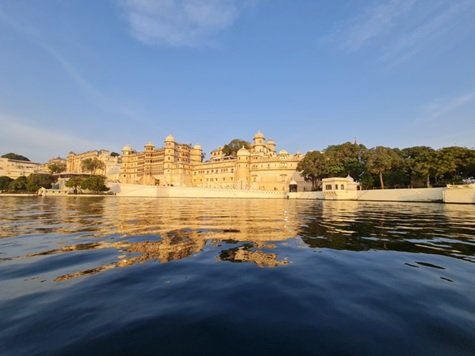
- Depart for Udaipur – one of India's most romantic cities, Udaipur has been dubbed the "City of Dreams" and the "City of the Rising Sun." Maharaja Udai Singh had the Blue Lakes built, (which reflect the hills of the Aravalli Mountains) for the needs of his new capital. The old town was surrounded by a fortified enclosure with 11 entrance gates, the ruins of which can still be seen. There are several magnificent palaces to visit in this alluring city, including the Hotel "Palais du Lac," an elegant whimsical white marble hotel.
- On arrival, we checked into the hotel and then free time.
- Lunch in Ranakpur at the local pizzeria.
Overnight and dinner at the hotel.
- Breakfast at the hotel.
- Then visit the city and palace of Udaipur.
- Visit the City of Dawn, one of India's most romantic cities! Your morning will be spent in peace and tranquility as you discover the labyrinths of the City Palace or Maharaja's Palace is the largest marble and granite complex in Rajasthan. The first building was built by Udai Singh, and then his successors added new wings, creating a real labyrinth. This palace contains magnificent rooms richly decorated.
- Visit the Sahelion-ki-Bari, with its pond covered with lotus flowers and marble fountains. Maharana Sangram Singh had this beautiful garden built in 1710 for his queen's bridesmaids. It is a pleasure garden nicknamed "Garden of the Bridesmaids" because the women of the royal family came to walk there. It has several beautiful fountains, kiosks and marble elephants. Its calm and atmosphere make it a popular place for walks.
- Rest of the free time to discover the bazaars, swimming pool or independent activities.
- In the late afternoon, boat trip on Lake Pichola (Not Private); to the island of Jag Mandir from where you will witness a beautiful sunset over the city.
- Lunch in the local restaurant.
- Dinner and overnight at the hotel.
Breakfast at the hotel and depart for Jaipur.
Continue to Pushkar and arriving at Lunch.
Afternoon visit to Pushkar Sacred Lake and a meeting with a priest who will explain Indian mythology with a prayer to attend and discover spirituality and peace at the edge of Pushkar Sacred Lake.
Check-in at your hotel.
Dinner and overnight at the hotel.
- Breakfast at the hotel.
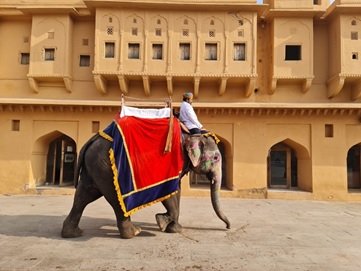
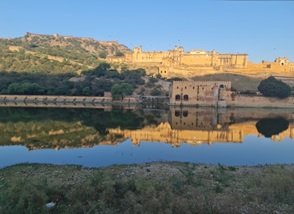
- Depart for the visit of the Amber Fort, the residence of Maharajahs. In the time of the Mughals, the region must have always been ready for war.
- After lunch visit to CITY PALACE, the private palace of the royal family and a close touch to know the royalty and wealth of Maharajas.
- Afternoon, Discovery of the local textile cooperative of JAIPUR, Carpets and cotton, handmade by the local families of Jaipur.
- Discovery of the city "JANTAR MANTAR", visit of the Jantar Observatory Mantar is a witness to the passion of Maharaja Jaisingh II for astronomy. He built observatories, including that of Jaipur (1728/1733). These monumental instruments with strange shapes, sundials, ramps and graduated arcs make it possible to read the latitudes and longitudes and the distances between celestial bodies, the time corresponding to the meridian of Jaipur, etc.
- End of the day, a rickshaw ride to make you discover the pink city and discovery of local jeweler to know the specialties of the city and local craftsmen.
- At the end of the evening, we admire the sunset on the ROOF TOP of a BAR for the Panoramic view.
- Return Dinner and overnight at the hotel.
- Breakfast at the hotel.
- Continue to Agra and check in to the hotel.
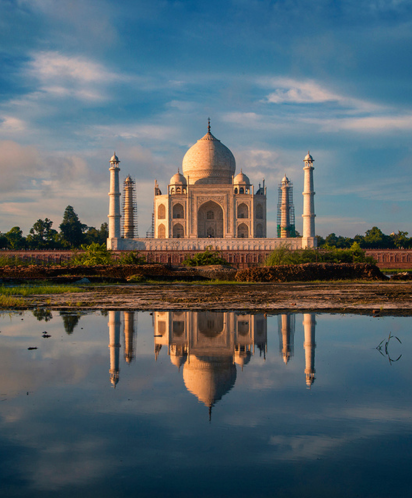
- At sunset visit the famous and moving Taj Mahal (closed on Fridays). It was built by the Mughal emperor Shah Jahan in memory of his beloved wife Mumtaz Mahal. The construction of the Taj Mahal began in 1631, the same year as Mumtaz Mahal's death, and was not completed until 1653.
- Dinner and overnight at the hotel.
- Breakfast at the hotel.
- Continue the road to Orcha.
- In the late afternoon, you will be transferred to Orchha, famous for its palaces and temples built in the 16th and 17th centuries. The architectural splendour of Orchha's monuments is a testament to the glory of its rulers. Upon arrival, check in to your hotel. Free evening or possibility to attend the sound and light show of the Orchha Fort. Overnight at the hotel in Orchha.
- You will visit the Orchha Fort, built on an island in the Betwa River. This architectural masterpiece is home to many temples and palaces. Three important palaces embody history in its purest form: the Jahangir Mahal, the Raj Mahal, and the famous Rai Praveen Mahal. The Jahangir Mahal represents the pinnacle of Orchha's architecture. The Raj Mahal is one of the most historic monuments of the fort, and the once magnificent Rai Praveen Mahal now preserves only the tales of a glorious past in its ruins.
- Arrive at the hotel, overnight at the hotel.
Breakfast at the hotel.
- Continue the road to Khajaroo.
- In the afternoon, you will visit the temples of Khajuraho, world famous for their erotic sculptures. You will discover the eastern group, the western group and the southern group of temples. Although all the temples are worth a visit, the main attractions are the Kandariya Mahadeva Temple, the Parsvanath Temple, and the Adinath Temple. These temples are dedicated to several Hindu gods and goddesses, as well as Jain deities.
- Of the temples still standing today, six are dedicated to Shiva, eight to Vishnu, one to Ganesh, one to the Sun god, and three to the Jain Tirthankaras. The largest of these temples is the Kandariya Mahadeva Temple, dedicated to the glory of Shiva. Renowned for their exceptional carvers and elegance, the magnificent temples of Khajuraho offer a perfect example of aesthetics. They are particularly known for their elaborate and intricate carvings, as well as for their erotic depictions. Although these sculptures depict various scenes of daily life, the temples of Khajuraho are best known for their artistic and erotic depictions of the female body, as well as the sexual practices of the time. The beauty and elegance of the temples of Khajurâho are indescribable. After your visit, you will be amazed by the refinement of the art, sculpture, and architecture of the tenth century. Rare are the places where all human emotions have been expressed with such mastery. The rest of the day is free.
- In the evening, you can enjoy the sound and light show organized by the Western Group of Temples, which will trace the history, the Chandela dynasty and the myths associated with the temples of Khajuraho. Overnight at the hotel in Khajuraho.
Dinner and overnight at the hotel.
- Breakfast at the hotel and transfer to the train station.
- We discovered the new fast train (VANDE BHARAT) with new technology, arrived in Varanasi around 2pm and transferred to the hotel.
- In the evening, we set out to attend the Ganges ceremony. One of the strongest experiences of spirituality and Hinduism. Hindus come in large numbers to pray and to live this moment of Energy.
- Dinner and overnight at the hotel. (Night in a 3-star hotel).
- Depart very early in the morning for a boat ride on the Ganges River.
- Life begins very early in the morning on the ghats of Varanasi, Hindus come to perform ablutions believing that Mother Ganges purifies their bodies and their sins. It is a time of calm, serenity and seeing the cremations on the edge of Manikarna Ghat where life ends for everyone.
- Before returning to the hotel, an orientation tower of BHARAT HINDU UNIVERSITY which has given the greatest scholars and politicians in the country.
- Return to the hotel and late breakfast, Free afternoon to rest and at the end of the afternoon we leave to discover SARNATH, the important and historical place of the time of BUDDHA.
- In the evening, you can go back to the ghats and walk to discover the local life one last time. (Supplement)
- Dinner and overnight at the hotel. (Night in a 3-star hotel)
- Breakfast at the hotel and drive to Gaya.
- Gaya is the capital of Gaya District, in the state of Bihar, and one of the oldest cities in India. Mentioned in the Ramayana and the Mahabharata, she was called Gayapuri.
- For Hindu pilgrims, Gaya is one of the holiest cities in the world. According to Hindu legend, the god Vishnu performed rituals (puja) there to redeem the souls of his ancestors, thus instituting the tradition of Shraddha and Pind Daan. The city's ghats and temples line the banks of the sacred Phalgu River, and the area is rich in sacred trees, including the highly revered Akshayavat (immortal banyan tree).
- Bodh Gaya — The Place of the Buddha's Enlightenment
- If there is a must-see place of pilgrimage in Buddhism, it is Bodh Gaya, in Bihar, India. It was there that Prince Siddhartha Gautama, after years of searching and forty-nine days of intense meditation under a pagoda fig tree, attained Nirvana—complete enlightenment—and became the Buddha ("the Enlightened One") around 528 BCE.
- The site fell into oblivion for more than a millennium, before being rediscovered during archaeological excavations carried out by the British in the nineteenth century, and then carefully restored. Today, it has returned to what it has always been: the holiest place in the world for nearly 500 million Buddhists, visited by pilgrims from Sri Lanka, Thailand, Japan, Myanmar, Tibet, Korea, China, Taiwan, Vietnam, Bhutan and the four corners of the Buddhist world.
- Walking around Bodh Gaya, especially in the early morning when the prayers of monks fill the air in a dozen languages, is one of the most deeply moving travel experiences in India.
Dinner and overnight at the hotel
- Breakfast at the hotel.
- We discover NEW DLEHI with the visit of old Delhi, the discovery of Jama Mosque, the largest mosque in India. A rickshaw ride to discover the streets of old Delhi with the charm of ancient time and magic of that era. Then, the discovery of Mahatma Gandhi's crematorium.
- In the afternoon, passing through the embassy quarters and the discovery of government buildings.
- Possibility to have lunch in the centre of Delhi in a modern restaurant.
- Transfer next to the airport for the farewell dinner and departure for your international flight.